
Lecce, known as the “Florence of the South,” is a city that enchants visitors with its extraordinary artistic and cultural heritage. Located in the heart of Salento, this Baroque jewel still preserves the traces of a glorious past, reflected in its monumental churches, noble palaces, and ancient remains that tell centuries of history.
One of the most fascinating features of its historic center is represented by the four gates of Lecce—ancient access points that once marked the entrances to the fortified city. These imposing structures were not merely passageways, but symbols of power and defense, designed to protect the city from enemy incursions and to regulate access for residents and visitors alike. Even today, these gates stand proudly, welcoming anyone who wishes to immerse themselves in the magical atmosphere of the historic center.
Walking among these gates means taking a true journey through time, rediscovering the evolution of Lecce over the centuries. Each gate tells a different story, connected to emperors, saints, and ancient traditions that have shaped the city’s identity. From the monumental Porta Napoli to the ancient Porta Rudiae, from the richly decorated Baroque Porta San Biagio to the understated elegance of Porta San Martino, these gateways are essential stops for anyone wishing to discover the authentic soul of Lecce.
If you are fascinated by history, art, and architecture, you cannot miss this itinerary through the four gates of Lecce. Through their stories, it is possible to understand the city’s strategic and cultural role, uncovering curious and surprising details about one of Southern Italy’s most captivating destinations. What are the four gates of Lecce, and what stories do they hide? Read on to find out.
Porta Napoli: The Monumental Entrance
Porta Napoli is perhaps the most imposing of the four gates of Lecce. Built in 1548 at the request of Emperor Charles V, this gate was erected in honor of an important visit by the emperor and to celebrate the military power of the Spanish kingdom. Its Renaissance style, characterized by a large triumphal arch inspired by Roman models, expresses the grandeur of the city at that time. With its decorative elements and massive Lecce-stone structure, Porta Napoli stands as one of the city’s most significant architectural symbols.
In addition to being a fundamental access point to the historic center, this gate also marked the beginning of the ancient road leading to Naples, from which it takes its name. Even today, crossing this threshold gives the feeling of entering a timeless Lecce, where history blends seamlessly with everyday life. Nearby, visitors can admire the evocative Lecce Obelisk—erected in honor of Ferdinand I of Bourbon—and the remains of the ancient city walls, which testify to Lecce’s long defensive tradition.
Porta Rudiae: The Oldest Gate in the City
Another of the four gates of Lecce is Porta Rudiae, considered the oldest. Its origins date back to Roman times, when it served as a connection to the city of Rudiae, the birthplace of the poet Quintus Ennius. The current structure is the result of an 18th-century reconstruction, following the collapse of the original gate. Today, it appears as a magnificent example of classical architecture, with a tall arch flanked by columns and topped by statues of Saint Oronzo, Saint Dominic, and Saint Giusto, the city’s patron saints.
The charm of Porta Rudiae also lies in its strategic position: passing through it leads directly into Lecce’s most authentic heart, among narrow alleys and ancient palaces. This entrance is particularly appreciated by history and architecture enthusiasts thanks to its sculptural decorations and Latin inscriptions that evoke the city’s ancient past. In the surrounding area, visitors can also find numerous local artisan workshops, where the mastery of Lecce stone craftsmanship can still be admired today.
Porta San Biagio: A Baroque Work of Art
Among the four gates of Lecce, Porta San Biagio stands out for its Baroque style, rich in decorations and sculptural details. Located in the southern part of the city, this gate is dedicated to Saint Blaise, an Armenian bishop and protector of the throat. The current structure dates back to the 18th century and features a large arch surmounted by the city’s coat of arms and the statue of the saint, who seems to watch over visitors as they pass through.
Porta San Biagio is a privileged access point for tourists, as it is located in one of Lecce’s liveliest areas, full of cafés, restaurants, and shops. In the evening, the lighting enhances the beauty of its sculptural details, making the gate even more evocative. Nearby stands the Castle of Charles V, an imposing fortress built to strengthen the city’s defenses and now home to cultural events and temporary exhibitions.
Porta San Martino: The Least Known Gate
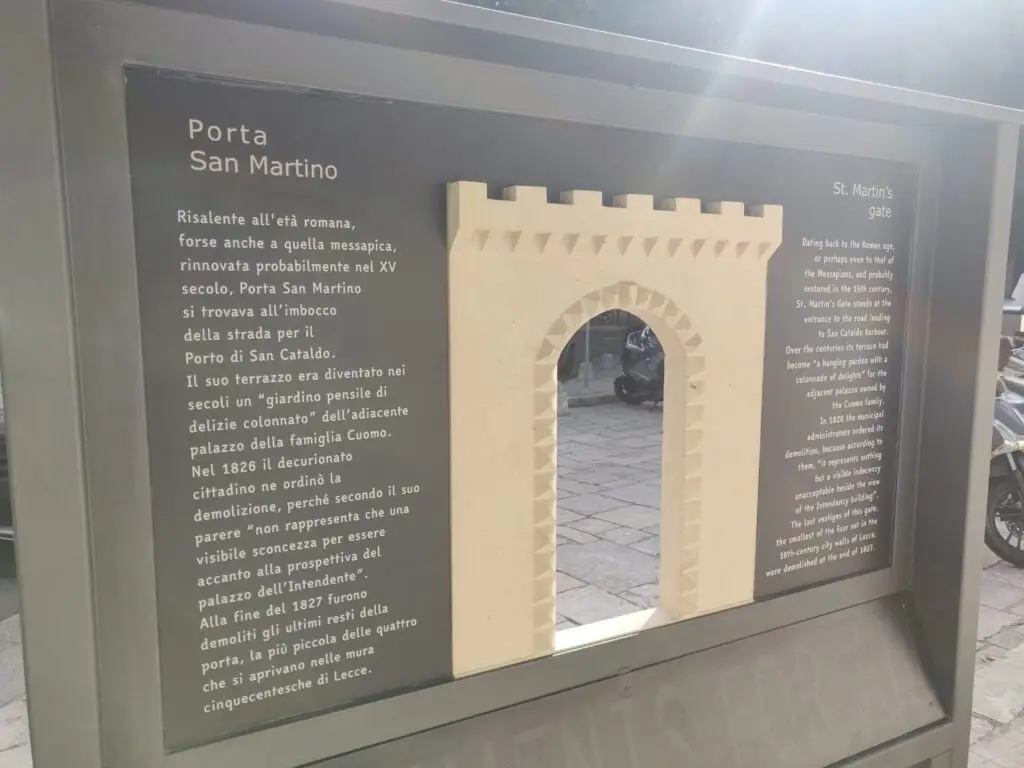
The last of the four gates of Lecce is Porta San Martino, often less considered than the others but still significant from a historical point of view. Located in a more secluded area compared to the other monumental entrances, this gate once served as a secondary access point to the city, mainly used by farmers and merchants. Its structure is simpler and less decorated, yet it retains the authentic charm of the ancient walls that once surrounded Lecce.
Despite its lower profile, Porta San Martino has considerable historical value, as it bears witness to the city’s architectural layering and gradual expansion over the centuries. In its surroundings, visitors can discover hidden corners of Lecce, away from mass tourism, where an authentic atmosphere still lingers. This quieter entrance is ideal for those who wish to explore the city in a more intimate way, allowing themselves to be surprised by its timeless beauty.
A Journey Through the History of Lecce
Visiting the four gates of Lecce means embarking on a journey through the city’s history, discovering its evolution over the centuries. Each gate tells a chapter of Lecce’s past, helping visitors better understand the culture and architecture of this fascinating corner of Puglia. These ancient gateways were not merely entrances, but control points for anyone wishing to enter the city. Each gate witnessed the passage of merchants, travelers, and military leaders, bearing witness to the political and social changes that have shaped Lecce over time. For those wishing to explore the city, a tour of its gates is a unique and unmissable experience.
Beyond their historical and architectural value, the four gates of Lecce offer an excellent opportunity to immerse yourself in the city’s daily life. Walking through these majestic entrances, you can admire charming stone-paved streets, elegant squares, and numerous artisan workshops where Lecce stone craftsmanship continues to thrive. Each gate serves as a starting point for exploring different areas of the historic center, leading to Baroque churches, ancient palaces, and evocative views that tell Lecce’s millennia-old story. This itinerary provides a privileged perspective on the city, allowing visitors to grasp its authentic soul and its perfect balance between tradition and modernity.